


KRISHNENDU KUNDU
16 minutes ago1 min read


KRISHNENDU KUNDU
23 minutes ago1 min read


KRISHNENDU KUNDU
42 minutes ago1 min read


KRISHNENDU KUNDU
51 minutes ago1 min read


5 Sept 2026
05:01:18 PM
SERVES FOR NATION


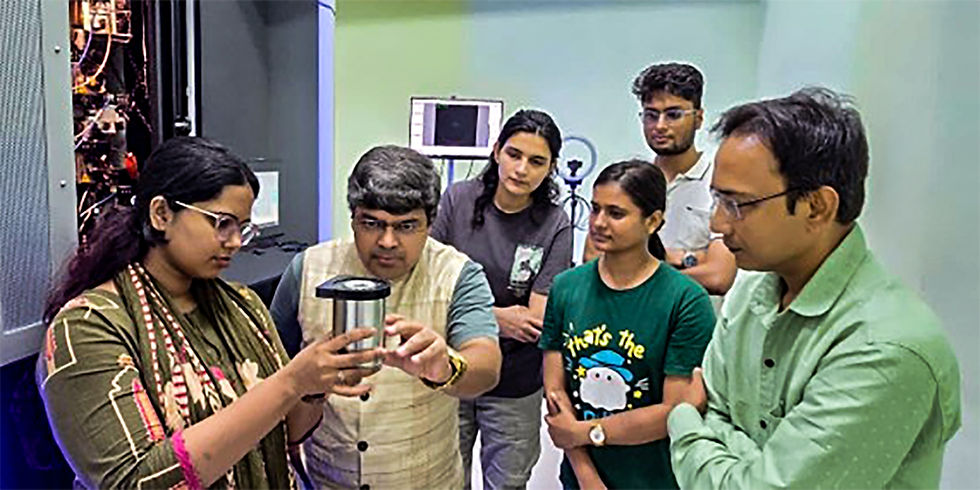
News Desk, News Nation 360: Researchers at IIT Kanpur, led by Prof. Arun K. Shukla and his team members Dr. Ramanuj Banerjee, Manisankar Ganguly, Annu Dalal, Sudha Mishra and Shachie Sinha, have demonstrated that they could de novo design small artificial miniproteins that bind and block G protein-coupled receptors (GPCRs) using an approach that does not require the traditional time-consuming and expensive process of high-throughput screening but rather uses artificial intelligence to arrive at candidate binders against a class of important cell surface receptors called GPCRs, including cancer and HIV associated chemokine receptors CXCR4 and CCR5, with IIT Kanpur's cryo-electron microscopy facility capturing the exact atomic detail of how designed miniprotein interacts with CXCR4 to open up the possibility of using artificial intelligence in accelerated precision discovery of medicines targeting such challenging and important cell surface receptors. The work done in collaboration with 2024 Nobel laureate Prof. David Baker's lab at University of Washington and supported by the Anusandhan National Research Foundation (ANRF), DBT and Lady Tata Memorial Trust is published in the journal Nature, titled "De novo design of miniproteins targeting GPCRs".
Pic: Courtesy

